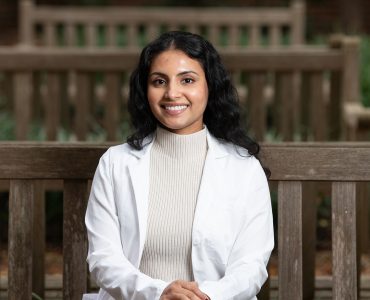

 Patricia Fanning
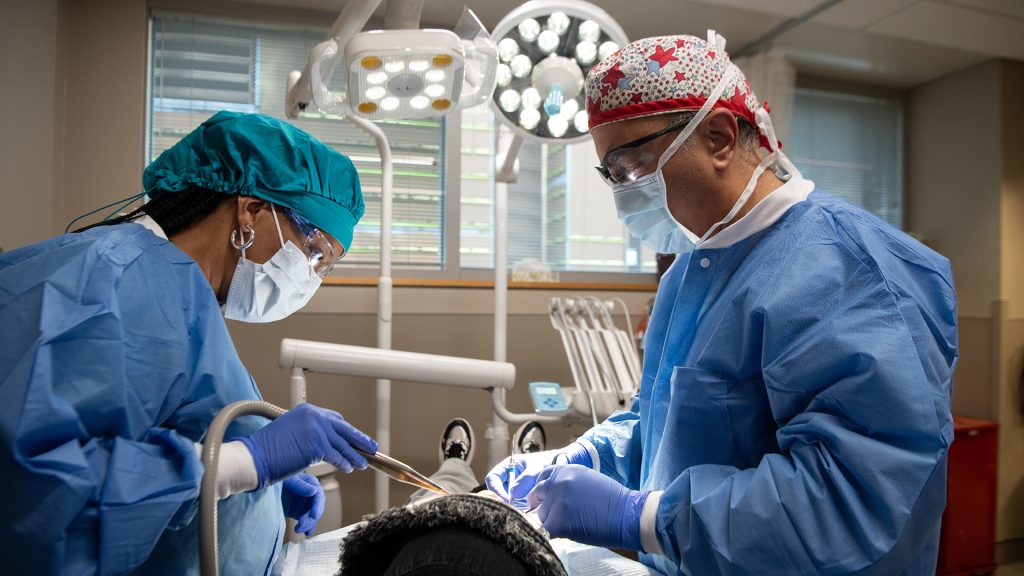
Dominic Legrant, a 42-year-old West Baltimore resident, came to the University of Maryland Medical Center’s (UMMC) downtown Emergency Department one recent evening suffering from a toothache. He had put in a strenuous day in his supervisory role at a warehouse, and as his shift wore on, pain flared in a rear molar that had been hurting for months.
“I wanted to leave so bad, but we had to meet a monthly deadline,” Legrant said.
At UMMC, he received pain medication, discharge instructions, and a referral to the University of Maryland School of Dentistry (UMSOD) for a next-day appointment — shortening his wait after Legrant had already had a long day.
He became a patient at UMSOD’s Emergency Dental Services (EDS) Clinic, a groundbreaking program established in collaboration with UMMC that streamlines emergency dental care. Clinicians at the main or Midtown Campus emergency department (ED) evaluate the patient and refer non-life-threatening cases to the dental school.
This new approach is designed to benefit not only the aching and injured patients needing dental treatment but the hospital where they first seek care.
In a pilot program, the EDS Clinic offers a greater range of oral health treatments than are feasible in a hospital ED setting.
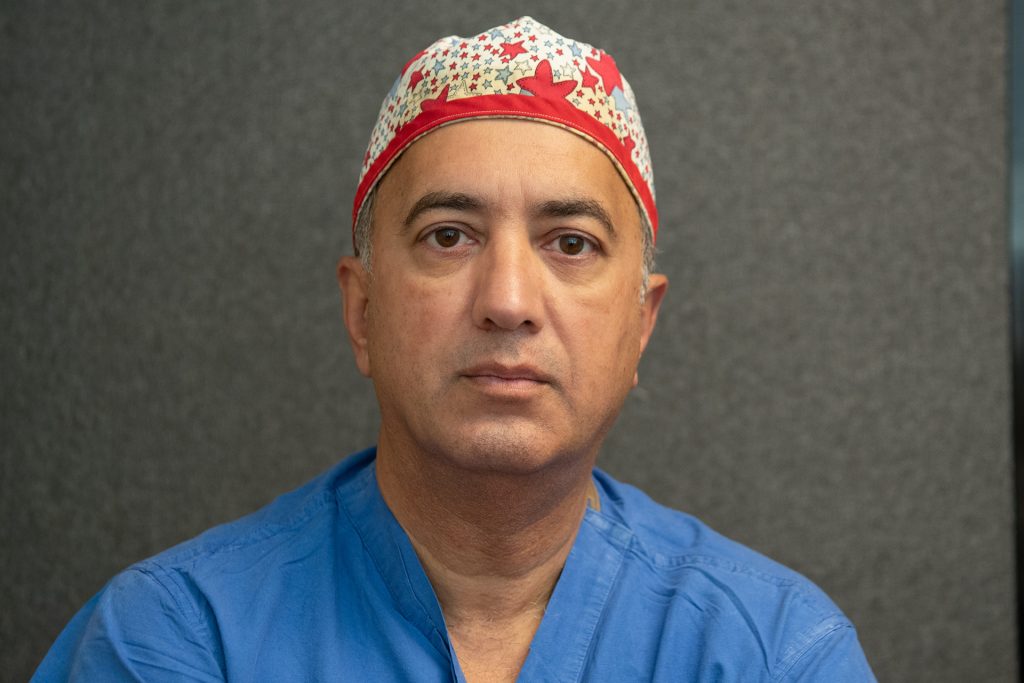
“It’s providing access to care that didn’t exist before,” said EDS Director and Division Chief Behzad Mostoufi, DDS, MDS, clinical assistant professor at the dental school. “Timely intervention in dental emergencies can prevent complications and improve clinical outcomes.”
The process has been met with overwhelmingly positive feedback at the hospitals, part of the University of Maryland Medical System.
“Our nurse practitioners, who evaluate most of these patients, consistently report that the workflow is easier, more efficient, and beneficial for patient care,” said Angela Smedley, MD, FACEP, FAAEM, medical director of the UM Access Center, which coordinates care and movement of patients across the system.
“This initiative has substantially improved access to dental follow-up care while reducing emergency department length-of-stay for patients with non-emergency dental and oral complaints,” said Smedley, assistant professor at the University of Maryland School of Medicine and associate vice chair of quality and safety, Department of Emergency Medicine.
A Referral for Comprehensive Care
Since opening last spring, EDS has treated more than 200 dental emergencies referred by EDs and counting. These include toothache sufferers such as Legrant, cases of broken teeth, and people afflicted with pain and swelling. That was the recent complaint of a woman diagnosed with an abscess.
During her EDS appointment, Mostoufi performed oral surgery to address the abscess and associated pus collection. “She was appreciative and felt much better after the procedure,” he said, adding that she later will receive comprehensive care at the dental school.
Nationally, dental emergency cases are seen as a burden on hospitals whose EDs are ill-suited to treat dental concerns. The problem is described as an “ineffective and expensive overuse of hospital emergency departments” in the 2021 federal report, “Oral Health in America: Advances and Challenges.” Often patients whose conditions are not life-threatening obtain little more than pain relief and antibiotics.
In Baltimore, the city health department found that hospital EDs are the primary source of health care for half of residents living below the poverty level. Demographically, nearby West Baltimore is regarded as an underserved community socio-economically.
This clinical partnership between a school of dentistry and an academic medical center is the first of its kind and may serve as a new care delivery model nationwide. Locally, the program may expand by contracting with other hospitals in the city and Baltimore County.
Protocol at UMMC
Here’s the protocol at UMMC, which shares a Department of Oral and Maxillofacial Surgery (OMS) with the dental school:
An oral health case presents to the Midtown or downtown ED, whose clinician performs triage. If the condition does not require observation, admission, or immediate treatment, the ED staff arranges an appointment at the EDS Clinic. The patient is discharged with a referral sheet, instructions, and directions to the dental school’s clinic at 650 W. Baltimore St. During its weekday hours, Midtown patients can be transported directly by courtesy shuttle. If the attending physician is unsure whether the patient is suitable for discharge and referral, an OMS resident is on call for consultation.
In the EDS Clinic, Mostoufi and other OMS clinicians perform surgical procedures. Endodontics, periodontics, and restorative services are made available within the dental school. Its existing Urgent Care clinic continues to see walk-in patients.
During Legrant’s EDS appointment, Ward Abu Jbara, DDS, reviewed options such as a root canal or extracting the molar. He outlined costs and prognosis, referring to an X-ray overhead. After some reflection, Legrant chose extraction.
Abu Jbara, an OMS intern, swiftly obliged.
The next day, Legrant felt “pretty good.” And, he added, “I was able to work without pain.”