
 Charles Schelle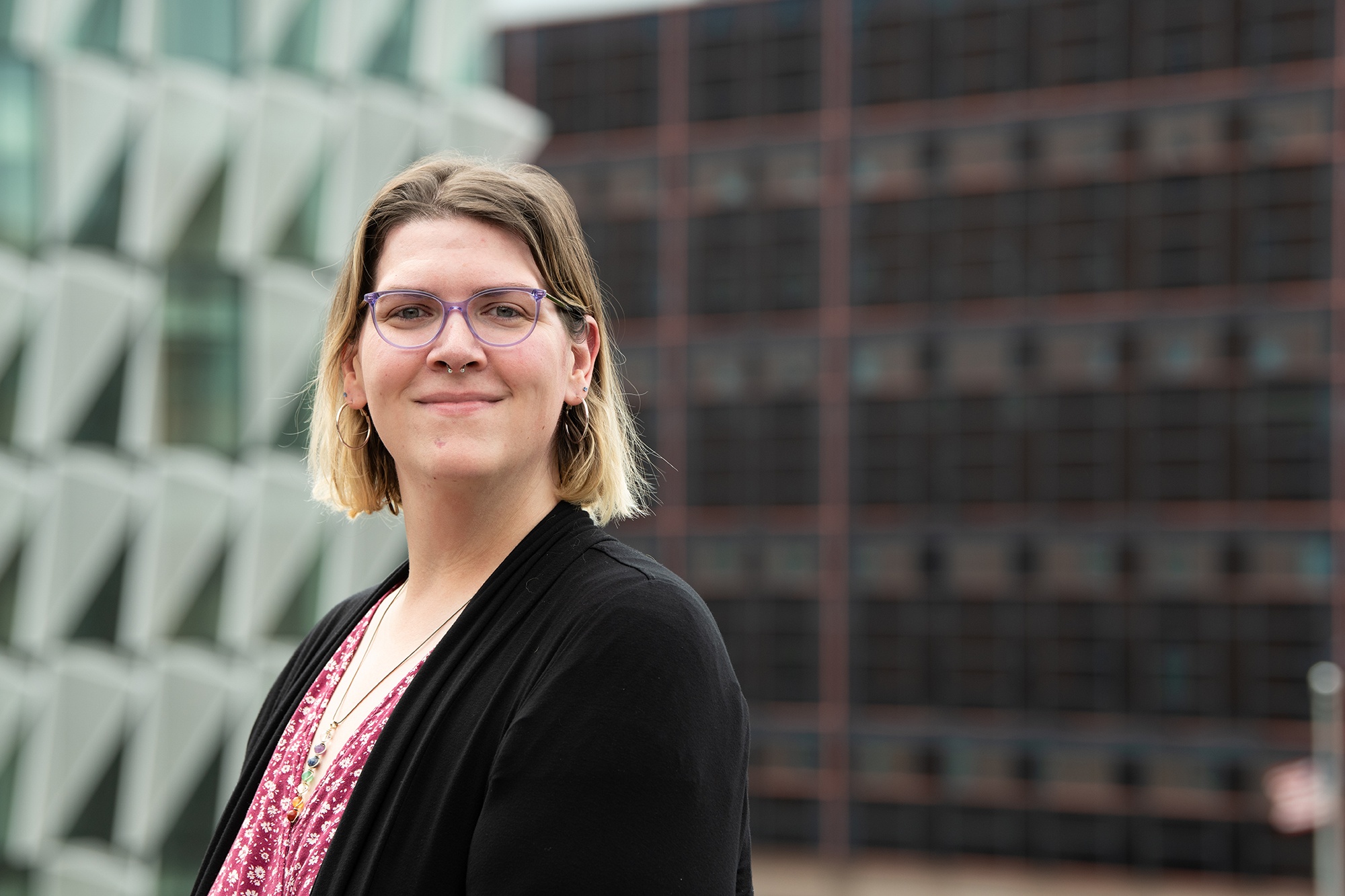
When Chloe Kastner opened the email, she wasn’t expecting it would be in response to something she applied for nearly two years ago. But, in many ways, it confirmed the work she had been building toward.
“Congratulations, Governor [Wes] Moore has appointed you to the Commission on LGBTQIA+ Affairs,” it read.
“It felt like a culmination of the work that I’ve done — like I’d been recognized in some way for the community work I’ve done over the last two years,” Kastner said.
That work, rooted in advocacy, community-building, and lived experience, defined Kastner’s time at the University of Maryland School of Social Work (UMSSW), where she graduated in May with a Master of Social Work degree in the Leadership, Policy, and Social Change concentration. It also earned her recognition as the 2025 UMSSW Student of the Year and propelled her into leadership roles, including president of the school’s Student Leadership Coalition.
But for Kastner, the path to that moment didn’t begin in a classroom. It started much earlier with questions she posed to herself.
A Journey of Visibility
Kastner, who is transgender, said she knew early in life that something about her gender felt different.
“I didn’t know exactly what it was, and it took me some time to figure it out,” said Kastner, who grew up in Baltimore and age 14 moved to Harford County, where she still lives.
It wasn’t until later that she began to see what was possible, shaping her purpose.
“One of the things that really helped me was seeing other trans people thriving and finding joy,” she said.
What began as a personal goal to make life easier for younger transgender people has expanded, which is fitting for a social work student.
“I just want the actions that I take to make things better for other people,” she said.
Kastner’s initial four-year appointment to Maryland’s LGBTQIA+ Affairs Commission places her at the center of efforts to assess community needs and shape policies that affect LGBTQIA+ residents across the state.
The 21-member commission, housed within the Governor’s Office of Community Initiatives, focuses on gathering direct input from communities and translating that into policy recommendations.
“I think a lot of the time, we presume what people need,” Kastner said. “It’s really important to get direct input … so we can influence legislation that actually makes a difference.”
That could range from helping someone who transitioned to have their name change updated on a utility bill to advocating for Maryland’s Medicaid program to make it easier to access long-term injectable pre-exposure prophylaxis.
Practice Makes Purpose
Before social work, Kastner spent a decade as a CarMax manager, where she advocated to improve gender identity policies. Seeing those changes make a difference for others inspired her career move.
“I thought, ‘I wonder if there’s something I can do that’s related to that,’ ” she said.
She enrolled in UMSSW’s macro social work concentration, now known as Leadership, Policy, and Social Change, where the 2011 University of Maryland, College Park criminology and criminal justice graduate found a framework that matched her interests and values.
A prerequisite course on structural oppression reassured her that UMB was the perfect fit.
“I feel like I can learn about policy and how to do a policy analysis in any program,” she said, “but to learn it through a lens of intersectionality and how aspects of your identity played into that really let me know I was in the right place.”
Faculty members say Kastner’s strength is how she brings those perspectives together.
“She approaches [clinical and macro practice] as deeply integral and complementary to one another,” said Samantha Fuld, DSW, MSW, LCSW-C, a clinical associate professor at UMSSW. “Chloe truly embodies the full range of social work practice as an advocate, connector, facilitator, convenor, and clinician.”
Looking Ahead
As president of the Student Leadership Coalition, Kastner focused on making student engagement more adaptable. Formerly called the SSW Student Government Association Executive Leadership, the coalition organizes events and advocates for UMSSW students, representing programs from Baltimore, the Universities at Shady Grove, and online.
When she joined, meetings drew only a handful of participants. Today, events attract 30 to 50 students — a shift she attributes to rethinking how leadership opportunities are structured.
Instead of rigid roles, the council now allows students to build initiatives around their own interests, from criminal justice reform to emerging advocacy efforts.
“Why don’t we just make flexibility one of our priorities?” Kastner said.
The result is a more responsive, student-driven model that mirrors her broader approach to leadership.
As she prepares to enter the workforce, Kastner plans to continue her focus on advocacy and policy.
Through it all, her North Star remains simple: “Is the thing I’m doing making people’s lives better?” Kastner said. “And if it is, then I’m going to keep doing it.”