

 Christianna McCausland
When Denise Thomma was 51 and entering menopause, she developed itchy bumps on her legs that spread to her shoulders, back, and arms over the course of a year. Initially, the bumps were just itchy. But with time, the “rash” became painful, bloody sores.
“I didn’t wear nice clothes; it hurt to be touched,” said Thomma, who, as a teacher of young children, said not being able to accept hugs was particularly difficult. She always wore long sleeves so the sores wouldn’t frighten her students.
“When I showered, I sobbed,” she recalled. “It actually hurt when water hit my skin. … I didn’t want to be touched anywhere by anyone.”
Imagine an itch you just cannot seem to scratch. It is a symptom so profound it keeps you up at night and causes you to call out sick to work. As a dermatological condition, your symptoms are likely there on the surface of your skin for all to see, impacting your self-worth and confidence, perhaps leading to depression. In fact, recent studies indicate the burden on quality of life associated with chronic itch is similar to that of suffering a stroke. And this condition is not a weight carried by the few; roughly one in four people will experience itch over their lifetime. Chronic itch accounts for 7 million physician visits a year.
And yet the condition has been largely overlooked. Until now.
In 2024, Shawn Kwatra, MD, joined the University of Maryland School of Medicine (UMSOM) as the Joseph W. Burnett Endowed Professor and Chair of Dermatology. Upon arrival he founded the Maryland Itch Center and a center for precision dermatology, all to address the needs of patients from all over the world who have suffered in the shadows. Kwatra’s leadership emphasizes building high-performing teams, accelerating scientific discovery, and expanding clinical access through an integrated academic mission.
“Itch may sound like an ordinary occurrence, but for many, it’s a life-altering symptom that’s been overlooked for far too long,” said UMSOM Dean Mark T. Gladwin, MD. “Thanks to Dr. Kwatra’s leadership, we now have a center that’s offering real hope — not just through compassionate care, but through groundbreaking science. His team’s work on immune profiling and the discovery of new inflammatory pathways is helping us understand these conditions in ways we never could before.”
Thomma was referred to Kwatra through the physician who was overseeing her asthma/allergy care. “Dr. Kwatra is engaging, knowledgeable, professional, personable, and always includes me in the process,” Thomma said. Kwatra diagnosed her with prurigo nodularis, a disease that causes disfiguring nodules and bumps, and prescribed once-a-month injections of a medication he was bringing to market, as well as a special shampoo and moisturizers. The impact on her life has been profound.
“Treatment has literally turned my life around,” she said. “I don’t shun people. I don’t avoid intimacy. I don’t cover myself up anymore. I don’t sob after showering. Pure joy.”
Unseen Suffering
Kwatra said his interest in patients like Thomma began earlier in his career, when he recognized a major gap in how academic medicine approached chronic itch. “The most suffering that I observed in dermatology were patients with severe itch whose suffering often went unseen, whose symptoms could not be easily measured or treated,” he said. This unmet need was not just in patients in the dermatology department; Kwatra also saw patients who suffered from severe kidney disease, liver disease, and spinal damage, as well as those receiving cancer therapeutics — all struggling.
“I realized itch is more than a symptom, it’s a condition that robs people of sleep, work, and their well-being. I also recognized that to impact patient care, chronic itch required the same level of scientific rigor, resource allocation, and programmatic development as other major chronic diseases,” he said.
The Maryland Itch Center is an extension of work being done in Kwatra’s lab, research that will impact many patients and grow the understanding of dermatological disease — both its causes and precision therapeutics to treat it. The center welcomes patients from across the nation and the world seeking relief from chronic, unexplained itch and itch associated with inflammatory skin diseases.
Under Kwatra’s leadership, the center has rapidly expanded its clinical footprint, research portfolio, and national collaborations, positioning the University of Maryland as a leader in chronic itch and inflammatory skin diseases. Kwatra routinely treats patients driving and flying long distances from around the country, and the center is leading internationally in the development of new therapeutics. for example, Kwatra was the lead global investigator on the study of nemolizumab, a humanized monoclonal antibody that targets the interleukin-31 receptor A (IL-31RA), for the treatment of prurigo nodularis. It is the medication that brought relief to Thomma.
His group is pioneering the use of targeted therapeutics, such as JAK inhibitors, for the treatment of itch disorders, and the center is now the lead coordinating site in the world for the Phase III clinical trial of two new such medications, povorcitinib and ruxolitinib. The group also has developed novel therapies to alleviate itch including greater occipital nerve blocks, ketamine infusions, and applications of medical cannabis. The center works closely with peer institutions at UMSOM such as the Institute for Genome Sciences and other departments and research core facilities.
Perhaps most exciting, the center recently discovered a new skin disease, IL-13+ IL-17+ erythroderma. “The discovery began with a single patient who came in with painful, full-body redness,” Kwatra said. “Using a flow cytometry-based test, we identified that both IL-13 and IL-17 cytokines were driving the inflammation. When we targeted both, the patient dramatically improved. That’s the power of precise, targeted medicine.”
That capacity for precision will be helped greatly by a new blood test Kwatra’s lab has patented and that he hopes can be used for the diagnosis and understanding not only of itching, but all inflammatory skin diseases.

Human Itch Mapping Project
To assist in this study, Kwatra has embarked on the Human Itch Mapping Project, an ambitious plan to create a detailed map of itch mechanisms — using immune cell signatures derived from the skin and blood, nerve pathway behavior, actigraphy, machine learning, and more — to quantify the patterns of scratching. The project recognizes that itching is a multisystem problem, spanning dermatology, internal medicine, neurology, psychiatry, and immunology. By creating this map of all the major skin diseases and looking for common threads among them, in conjunction with the new blood test, the goal is to help identify new, targeted therapeutics.
“One of our big advances is learning new biomarkers to help guide therapeutic selection,” Kwatra said. “It’s very exciting that we’re able to use precision dermatology to help guide treatment through making an itch map and mapping many of these different diseases, because it’s been so understudied to date.
“This enables precision therapy, matching patients with biologics or small molecule drugs based on immune neural structure signatures, and I think that’s the future,” he said.
Part of what drew Kwatra to Maryland was the commitment of senior leadership at UMSOM and the University of Maryland Medical Center (UMMC) to develop a leading academic dermatology department. One reason the study of chronic itch has languished is the long-standing lack of investment in academic dermatology as many medical graduates shifted into private practice rather than the academic pipeline. Thanks to active recruiting, strategic investment, and a renewed institutional mindset, the University of Maryland arguably has the fastest-growing dermatology department in the United States.
‘Tremendous Vision’
Central to Kwatra’s leadership is fostering a mission-driven culture — one that empowers faculty, integrates research with clinical excellence, and positions dermatology as a vital contributor to the school’s broader academic and community impact. He leads with a vision of intentional growth, investing in people, infrastructure, and collaborative science to expand access and accelerate innovation. In fact, the department recently opened two state-of-the-art sites in Lutherville and Columbia, has increased patient visits by more than 300 percent since his arrival, and transformed access from months-long waits to same-day availability.
“Dr. Kwatra has brought tremendous vision and enthusiasm to the department of dermatology — building a team that’s growing fast, attracting top talent, and expanding access to care across Maryland,” Gladwin said. “The Human Itch Mapping Project and the Center for Precision Dermatology are pushing the boundaries of what’s possible — using tools like single-cell sequencing and spatial transcriptomics to get to the root of disease and match patients with the right treatments. This is the kind of innovation that makes a real difference in people’s lives, and I’m proud to support it.”
That level of support is important to Kwatra. “There’s real momentum right now. We’re seeing fresh energy in our department, also in our field. New investigators, new technologies, a new redefined sense of purpose and mission,” he said, noting that Gladwin and UMMC President Bert O’Malley, MD, have encouraged him and his department to think ambitiously, including integrating their research program into the institution’s broader missions. “Maryland has a unique ecosystem in that there’s deep scientific expertise, a thriving hospital and medical system, and a genuine focus on serving our community through all of our system hospitals as well,” Kwatra added.
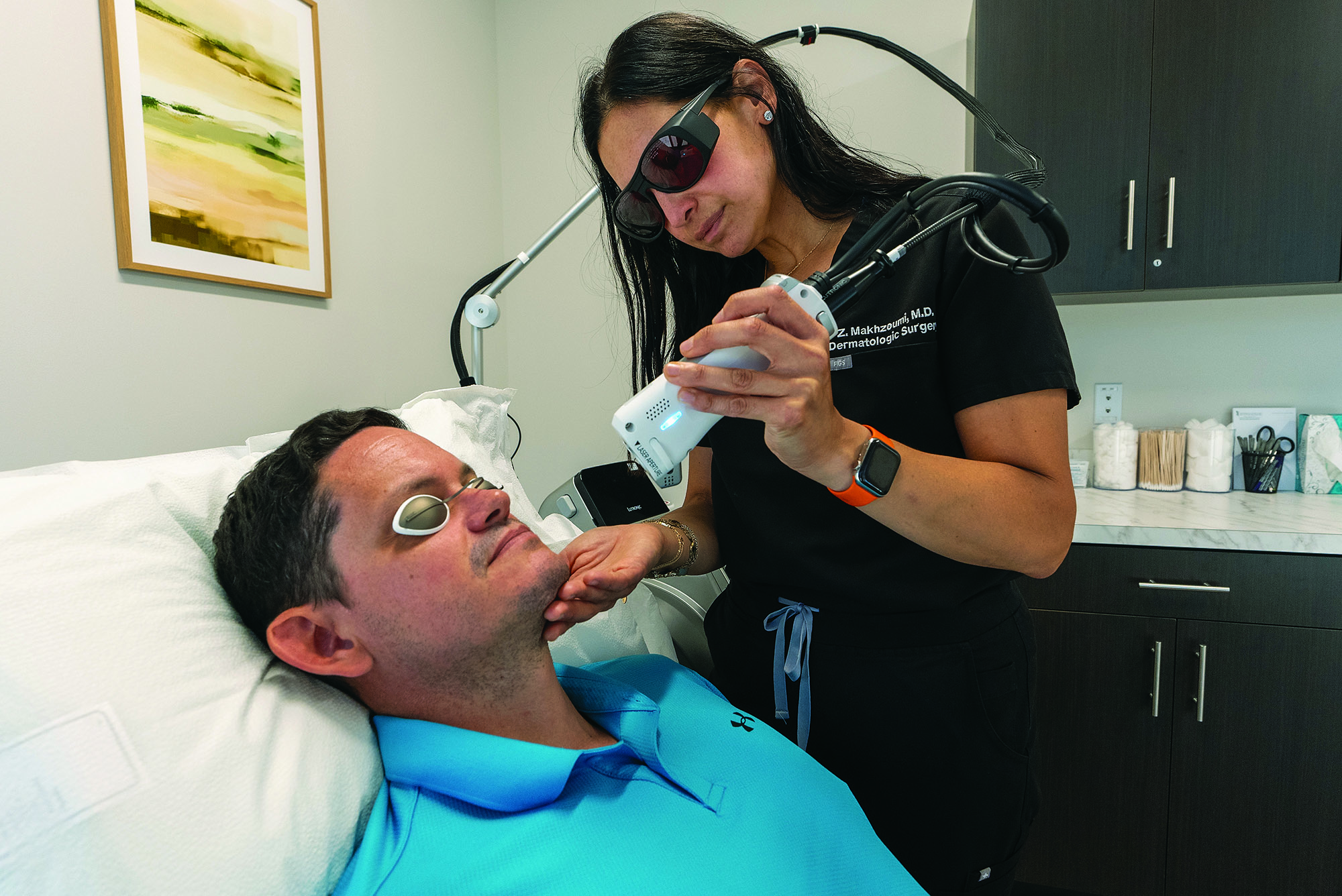
‘Interdisciplinary Collaboration’
It’s work that has increasing relevance as the diagnosis of chronic itch and other dermatologic conditions rises. That’s due in part to better diagnostics capturing people who were overlooked before, but the actual number of people impacted also appears to be growing. Kwatra said this is likely due to a number of converging factors: environmental and lifestyle changes, increased pollution, stress, altered microbiomes, processed foods, and longer life expectancy, which increases the prevalence of chronic, systemic diseases such as diabetes that come with skin symptoms.
“Dermatology is rapidly emerging as one of the most important specialties in medicine,” Kwatra said. “What we’re learning is that the skin isn’t just a covering, it’s an immune and a sensory organ, and it communicates constantly with the nervous system, with the immune system, and when it’s inflamed, the entire body feels it.”
This connection explains why the Itch Center has a cardiologist doing Grand Rounds. Manu Mysore, MD, is an assistant professor at UMSOM and co-medical director of the cardio-oncology program. While he might seem an unlikely candidate to be interested in dermatology, he said, “My overarching goal is to understand how systemic inflammation, immune dysregulation, and targeted cancer therapies affect the cardiovascular system — and how collaboration across specialties can prevent and manage these complications more effectively.”
Because Kwatra is a leading expert in dermatologic inflammation and chronic pruritus, “His expertise in dermatologic immunology complements my work in inflammation-driven cardiac injury, forming a natural foundation for collaboration,” Mysore said. Kwatra and Mysore recently discovered that the pruritic skin disease prurigo nodularis has elevated C-reactive protein levels, elevated cardiac biomarkers and risk factors, and increased risk of adverse cardiac events.
In fact, Mysore and Kwatra aim to establish cardio-dermatology as an interdisciplinary specialty. Mysore said there are many links between the two areas. Inflammatory skin diseases share cytokine and endothelial dysfunction pathways that accelerate atherosclerosis and heart failure, for example, and targeted cancer therapies can cause dermatologic and cardiac toxicities. Cardiovascular medications can provoke dermatologic side effects, and dermatologic manifestations might signal systemic cardiac or vascular disease.

The patient impacts of this collaborative work could be strikingly positive — earlier detection of cardiac risk through dermatologic and inflammatory screening, reduced hospitalizations and severe cardiovascular events, and overall improved survival rates and quality of life.
“Interdisciplinary collaboration is vital because disease processes rarely respect organ boundaries,” Mysore said. “By integrating dermatology and cardiology perspectives, we create holistic, anticipatory care pathways that improve patient safety and outcomes. Our collaboration also facilitates translational research, bridging molecular and clinical domains.”
The realization that skin health is whole body health is what has emerged. And the University of Maryland is poised to lead research, clinical care, and innovative translational medicine at this time of profound evolution in the field of dermatology.
“At Maryland, there is a shared vision: We want to create a center and dermatology department that leads nationally in research, training, and the compassionate clinical care of patients with the most challenging skin diseases,” Kwatra said. “This is a place where innovation is meeting impact, and our Maryland Itch Center is growing and leading as a world-class destination for relief, discovery, and hope.”
This story originally was published in the winter issue of the University of Maryland Medicine’s Bulletin.